Table of Contents >> Show >> Hide
- Why funny church signs became a small-but-mighty pandemic tradition
- 16 funny church-sign-style messages (with meaning behind the laugh)
- 1) Love your neighbor. From six feet away.
- 2) Faith is contagious. Please don’t be.
- 3) The safest hug is a wave.
- 4) We’re open. Our pews are just… socially selective.
- 5) Mask up. God can read lips, but we can’t.
- 6) This is a “come as you are” churchjust wash your hands first.
- 7) If you’re feeling distant, you’re doing it right.
- 8) Our livestream has unlimited seating.
- 9) Choir practice canceled. Humming encouraged.
- 10) Communion is sacred. So is good ventilation.
- 11) Don’t worryour collection plate accepts “elbow bumps.”
- 12) Judgment-free zone… except for uncovered sneezes.
- 13) The good news: grace is free. The bad news: so are germs.
- 14) Pray for patienceespecially in the vaccine line.
- 15) If you can read this, you’re close enough to smileunder your mask.
- 16) We miss you. We’re protecting you. That’s the same thing.
- What made the best signs work
- How to write your own funny (and kind) pandemic-era-style church sign
- Conclusion
- Experiences: What people actually felt when they saw these signs (and why it mattered)
In the early days of COVID-19, the world felt like it was running on three things: hand sanitizer, group texts, and anxiety. And thenlike a bright little lighthouse on the side of the roadchurch marquee signs started dropping one-liners that were equal parts public-service announcement and holy stand-up routine.
These signs weren’t trying to “make light” of serious loss. They were trying to make room for breathespecially for people who were scared, lonely, and exhausted. Humor can help people feel calmer and more content during stressful periods, including pandemic stress, which is why those quick jokes often landed like a warm cup of coffee on a cold day. (Also: a church sign can say a lot with very few letters, which is basically the original character limit challenge.)
Why funny church signs became a small-but-mighty pandemic tradition
Church signs have always been the community’s “front porch.” They’re visible to everyone: members, neighbors, and the random driver who’s just trying to find a drive-thru. During COVID-19, that porch turned into a bulletin board for safety reminders: masks, distancing, hygiene, staying home when sick, and respecting local guidance. Public health agencies emphasized layered strategiesespecially masks and distancing in higher-risk situationsto reduce spread. Churches, like other community spaces, had to translate that into everyday language people would actually remember. And sometimes the best translation is… a pun.
At the same time, religious life in the U.S. changed quickly. Many congregations paused in-person gatherings or re-opened with modifications, and online services became common. The result was a strange mix of distance and togetherness: physically apart, socially connected, spiritually determined. Church signs helped stitch that feeling togetherone joke at a time.
16 funny church-sign-style messages (with meaning behind the laugh)
Below are original, marquee-style sign ideas inspired by real pandemic-era themes: kindness, safety, patience, and neighborly love. They’re written to sound like what you’d see on a roadside signshort, punchy, and easy to remember.
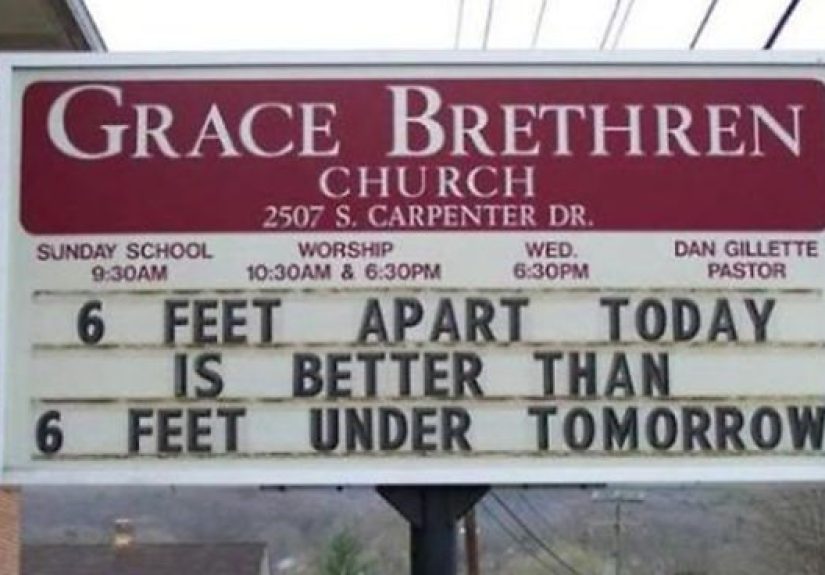
1) Love your neighbor. From six feet away.
Sign: “LOVE THY NEIGHBORAT A SAFE DISTANCE”
The joke is the contrastlove feels close, safety requires space. But the message is actually deeply practical: caring for people sometimes means changing your habits to reduce risk, especially indoors and in crowded settings.
2) Faith is contagious. Please don’t be.
Sign: “LET FAITH SPREAD… NOT GERMS”
A gentle reminder that spiritual encouragement can travel without physical contact. It also nudges people toward smart prevention: stay home when sick, test when appropriate, and be thoughtful about gatherings.
3) The safest hug is a wave.
Sign: “WAVES ARE THE NEW HUGS (FOR NOW)”
It acknowledges what people misstouch and closenesswhile offering a substitute. That “for now” matters, too: it validates that restrictions felt temporary, even when time felt slow.
4) We’re open. Our pews are just… socially selective.
Sign: “SAME CHURCH, DIFFERENT SEATING CHART”
Congregations that reopened often used spacing, limited capacity, and other changes. Humor made those adjustments feel less like scolding and more like teamwork.
5) Mask up. God can read lips, but we can’t.
Sign: “GOD HEARS YOU. WE NEED MASKS.”
The laugh comes from the logic twist. The point: masks are a simple barrier that can reduce spread, especially when people are close together or indoors.
6) This is a “come as you are” churchjust wash your hands first.
Sign: “COME AS YOU ARE… CLEAN HANDS PREFERRED”
It pairs welcome with responsibility. Hand hygiene became a daily ritual during the pandemic, and rituals are something faith communities understand well.
7) If you’re feeling distant, you’re doing it right.
Sign: “FEELING DISTANT? THANK YOU.”
It flips an uncomfortable feeling into a positive action. Distancing wasn’t about being coldit was about being careful.
8) Our livestream has unlimited seating.
Sign: “ONLINE SERVICE: NO PARKING PROBLEMS”
Online worship helped people stay connected when gathering wasn’t safe or possible. This sign turns a limitation into a perk (the spiritual version of “free shipping”).
9) Choir practice canceled. Humming encouraged.
Sign: “SING IN YOUR HEART (AND MAYBE YOUR CAR)”
Singing in groups was complicated in early COVID conversations because of shared air and indoor risk. This sign keeps the joy while lowering the volumeliterally.
10) Communion is sacred. So is good ventilation.
Sign: “HOLY MOMENTS + FRESH AIR = GOOD PLAN”
A wink at a real lesson: indoor airflow matters. Many prevention recommendations increasingly emphasized ventilation as one more layer of protection, especially for shared indoor spaces.
11) Don’t worryour collection plate accepts “elbow bumps.”
Sign: “GIVING THANKS (NOT HANDSHAKES)”
Humor gave people permission to skip old habits without feeling rude. That mattered because social norms can be surprisingly hard to breakeven when they involve germs.
12) Judgment-free zone… except for uncovered sneezes.
Sign: “SNEEZE INTO YOUR ELBOW. WE’RE WATCHING.”
It’s playful accountability. “Respiratory etiquette” became a mainstream phrase, but this sign translates it into something memorable.
13) The good news: grace is free. The bad news: so are germs.
Sign: “GRACE IS FREE. BE CAREFUL ANYWAY.”
A reminder that compassion and caution can coexist. Caring for people includes reducing preventable harmespecially to those at higher risk.
14) Pray for patienceespecially in the vaccine line.
Sign: “PATIENCE: NOW SERVING EVERYONE”
The rollout period demanded patience and empathy. This one turns waiting into a shared practice instead of an individual annoyance.
15) If you can read this, you’re close enough to smileunder your mask.
Sign: “SMILE ANYWAY. WE’LL ASSUME IT’S GREAT.”
Masks covered faces, but not friendliness. This encourages warmth without ignoring safetyan important balance for community spaces.
16) We miss you. We’re protecting you. That’s the same thing.
Sign: “WE’RE APART BECAUSE WE CARE”
This one isn’t a punchlineit’s a heartline. It frames precautions as love in action, which is what many communities needed to hear when fatigue set in.
What made the best signs work
They were funny without being cruel
COVID-19 brought real grief. The best signs didn’t mock fear or loss. They used humor to lower shoulders, not raise defensesmore “we’re in this together” than “look who’s doing it wrong.”
They turned guidance into something sticky
“Mask + distance + hygiene + smart choices” can sound like background noise. A clever line turns it into a moment your brain actually keeps. Research on humor suggests it can boost positive emotions and help people cope with stress, which may be part of why these messages felt so relieving in the middle of nonstop uncertainty.
They sounded like a neighbor, not a lecture
Marquees work because they’re plainspoken. You don’t need a footnote to understand, “Wave instead of hug.” You just… wave. And honestly, sometimes that’s the whole win.
How to write your own funny (and kind) pandemic-era-style church sign
Keep it short
If it can’t be read at 35 miles per hour, it’s not a church signit’s a roadside novel. Aim for one idea and one twist.
Make the “why” feel loving
People accept restrictions more easily when they feel respected. Tie safety to care: protecting elders, protecting kids, protecting the nurse in the congregation who’s tired.
Avoid shaming language
Humor can unite or divide. Choose the kind that invites the whole community inespecially the anxious, the exhausted, and the people who are trying their best.
Stay aligned with local guidance
Public health recommendations evolved across the pandemic, and communities varied. The safest approach: keep your message general (kindness, hygiene, staying home when sick) and point people toward local updates for specifics.
Conclusion
Funny church signs about coronavirus weren’t just jokes on plastic letters. They were tiny community check-insquick reminders that you’re not alone, that safety can be an act of love, and that hope doesn’t disappear just because the sanctuary is quieter than usual.
If you’re creating content about these signs today, the sweetest angle is still the same: laughter is often how communities carry each other through hard seasons. And sometimes the most practical sermon is 12 words long and posted right next to the road.
Experiences: What people actually felt when they saw these signs (and why it mattered)
Ask almost anyone what they remember most about the pandemic and you’ll hear a mix of big moments and tiny ones: empty highways, masked grocery runs, muted birthdays, the weird joy of finding flour again. Church signs landed in that “tiny but memorable” category because they showed up in the middle of ordinary errandsright when people needed a reason to unclench their jaw.
For some families, the weekly drive became the new routine: not necessarily to go inside the building, but to pass by the familiar place and feel a thread of continuity. A short linesomething like “We’re apart because we care”could feel like a message personally delivered, even though it was meant for everyone. It was a reminder that the community still existed, even if the chairs were stacked and the choir robes stayed in the closet.
Others experienced these signs as a kind of social permission slip. When you’re the person who wants to be carefulwho worries about grandparents, asthma, or a high-risk friendhumor can take the edge off awkward moments. A sign that normalizes waving instead of hugging makes it easier to do the safe thing without feeling like you’re rejecting people. It reframes boundaries as kindness, not distance as coldness.
And then there was pandemic fatiguethe long middle stretch where everyone was tired of news alerts and tired of arguing and tired of feeling like every decision had a moral soundtrack. That’s where the best jokes helped most: not by pretending things were fine, but by giving people a brief mental break. Research-backed conversations about humor and coping basically confirm what people already sensed in their bones: laughter doesn’t erase stress, but it can soften it enough to keep going.
Communities also used these signs to keep connection with those who weren’t online. Not everyone couldor wanted towatch a livestream. A marquee was a low-tech broadcast that reached everyone: the essential worker driving home late, the lonely neighbor taking a “just to get out of the house” loop, the teenager in the back seat who finally looked up from their phone because the punchline was actually good. In that way, the sign became a mini-meeting place: no gathering required.
Looking back, many people describe a surprising tenderness in these moments. A church sign is simple. It doesn’t debate. It doesn’t doomscroll. It just says, “We see you,” in block letters. And in a time when isolation felt heavy and uncertainty felt loud, being seenplus a small laughwas a real form of comfort. Even now, the memory of those signs can trigger the same reaction: a quick smile, then a quiet thoughtwow, we got through that together.