Table of Contents >> Show >> Hide
- Why Binoculars Look Blurry in the First Place
- Before You Focus: Set Up the Binoculars Correctly
- How to Focus Binoculars Step by Step
- How to Focus Faster in Real-World Situations
- How to Tell If Your Binoculars Are Truly in Focus
- Common Binocular Focusing Mistakes
- Troubleshooting a Blurry View
- Best Habits for Keeping Binoculars Easy to Focus
- What Focusing Binoculars Feels Like in Real Life: Experience-Based Tips
- Conclusion
Binoculars are supposed to make the world look better, not turn a majestic hawk into a fuzzy flying meatball. Yet that is exactly what happens when your binoculars are not adjusted to your eyes. The good news? Learning how to focus binoculars is not complicated. Once you understand a few key controls and use them in the right order, you can go from blurry and frustrating to crisp and glorious in under two minutes.
Whether you use binoculars for birding, hiking, sports, wildlife watching, boating, or stargazing, the secret to a sharp image is not just turning the center wheel until things “sort of” look okay. Proper focus starts with fit. Then it moves to diopter adjustment. After that, everyday focusing becomes fast, easy, and surprisingly satisfying. This guide walks you through the full process, explains why blurry views happen, and helps you troubleshoot common problems so you can spend less time fiddling and more time actually seeing.
Why Binoculars Look Blurry in the First Place
If your binoculars are not giving you a sharp, clear view, the focus wheel is not always the villain. Sometimes the real issue is that the binoculars are not set up for your face or your eyesight. Binoculars have to match the distance between your eyes, the way you use eyecups, and any difference in strength between your left and right eye. Skip those steps, and even expensive optics can look unimpressive.
Here are the usual suspects:
- The eyecups are in the wrong position. If you wear glasses and the eyecups are extended, or if you do not wear glasses and the eyecups are collapsed, the image can look shadowy or incomplete.
- The barrels are set too wide or too narrow. This changes your interpupillary distance, which is just a fancy way of saying the space between your pupils.
- The diopter is not matched to your eyes. This is the most common reason one side seems sharp while the other seems a little “off.”
- You are trying to focus on a moving subject too soon. Focusing on a flitting warbler is a bit like trying to tie your shoes on a trampoline.
- The lenses are dirty. Dust, fingerprints, and smudges can soften the image enough to make you think the optics are out of focus.
Once you handle those basics, focusing binoculars becomes much easier. In fact, after the first setup, most of your day-to-day focusing is done with just one control: the center focus wheel.
Before You Focus: Set Up the Binoculars Correctly
1. Adjust the Eyecups
Start with the eyecups. If you wear glasses, twist or fold the eyecups all the way down. This helps your eyes get close enough to the lenses to see the full field of view. If you do not wear glasses, keep the eyecups up so your eyes sit at the right distance.
This one small step makes a huge difference. If you have ever looked through binoculars and seen black crescents, dark corners, or a tunnel-like image, the eyecups may be the reason. They are not decoration. They are the little bouncers managing your eye position.
2. Set the Interpupillary Distance
Next, hold the binoculars up to your eyes and slowly move the barrels closer together or farther apart. Stop when the two separate circles merge into one clean circular image.
If you still see blacked-out edges or a figure-eight shape, keep adjusting. Once the image becomes one full circle, the binoculars match the width of your eyes. That means you have cleared the first major hurdle toward a sharp, comfortable view.
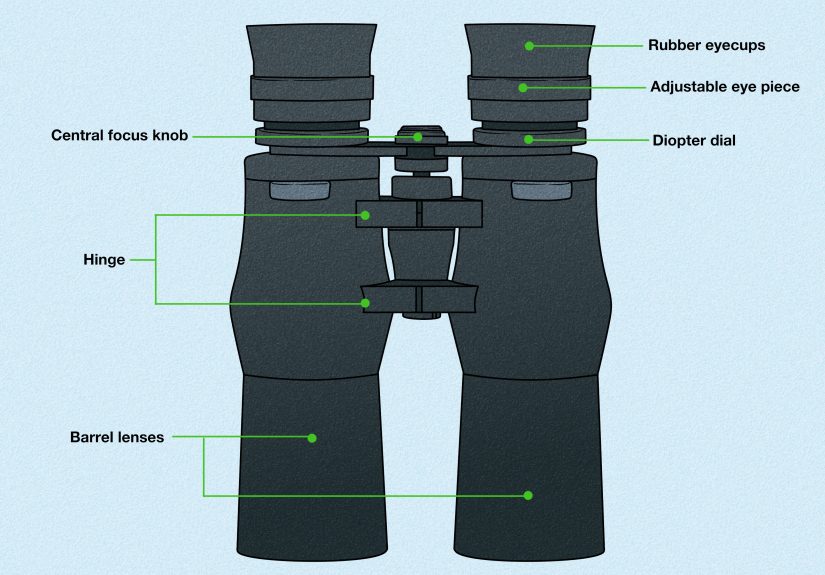
3. Find the Focus Wheel and the Diopter
Most modern binoculars have two main focusing controls:
- Center focus wheel: This adjusts both barrels at the same time.
- Diopter adjustment: This fine-tunes one side, usually the right eyepiece, to account for differences between your eyes.
The center wheel handles your general focusing. The diopter is your personal calibration. Think of it as the “set it once, benefit all day” control.
How to Focus Binoculars Step by Step
Now for the main event. This is the standard method for focusing center-focus binoculars.
Step 1: Choose a Still, Detailed Target
Pick something stationary with clear detail, like a license plate, tree bark, a sign, or a branch with texture. It should be far enough away that you are not fighting close-focus limits. Somewhere beyond about 20 feet usually works well, and farther is often even easier.
Do not start with a squirrel on espresso. Use something that stays put.
Step 2: Set the Diopter to Neutral
If your binoculars have a zero mark or center mark on the diopter, set it there before you begin. If there is no obvious mark, just place it in a middle position. You are about to tune it to your vision anyway.
Step 3: Focus the Left Eye with the Center Wheel
Cover the right objective lens or close your right eye. Then look at your target through the left side of the binocular and turn the center focus wheel until the image looks as sharp as possible.
Take your time here. Fine details matter. If you can see edges cleanly and the image “snaps” into focus, you are in the right spot.
Step 4: Focus the Right Eye with the Diopter
Now cover the left objective lens or close your left eye. Keep the binoculars pointed at the same target. This time, do not touch the center focus wheel. Instead, turn the diopter adjustment until the image in your right eye becomes equally sharp.
This is the step many people skip, and then they spend the rest of the outing wondering why their binoculars feel slightly annoying. Do not rob your future self of crispness.
Step 5: Uncover Both Sides and Check the View
Look through both eyepieces with both eyes open. Your image should now appear sharp, balanced, and comfortable. From this point on, you usually only need the center focus wheel to adjust for objects at different distances.
If your binoculars have a locking diopter, lock it now. If not, make a note of the setting so you can quickly return to it later if someone else borrows your binoculars and “just wants to try them for a second.” We all know how that story ends.
How to Focus Faster in Real-World Situations
Birding and Wildlife Watching
When watching birds or animals, speed matters. The best trick is to look at the subject with your naked eyes first. Keep your gaze fixed on it, then raise the binoculars to your face without looking away. Once the subject appears in view, use the center wheel for a quick final adjustment.
Another smart move is to pre-focus on the approximate distance where you expect activity. If birds are landing in the same tree or deer are moving along the same tree line, focus there before the action starts. That way you are not spinning the wheel wildly while your target exits the stage.
Sports and Stadium Use
For sports, focus on the area where the action is most likely to happen rather than trying to chase every movement. If you are watching baseball, set your focus near the mound or batter’s box. If you are at a soccer game, stay near midfield and make smaller focus corrections as play shifts.
This reduces over-adjusting, which is a very real condition brought on by enthusiasm and snacks.
Boating and Marine Use
Some marine binoculars use individual focus rather than a center wheel. That means each eyepiece is adjusted separately. These models are often designed for long-distance viewing where everything beyond a certain point stays acceptably sharp. If you have this style, you will set each eyepiece for your eyes instead of using one center focusing system.
If your view bounces around on the water, that may not be a focus problem at all. Motion, glare, and hand shake can make a sharp view feel unstable. Brace your elbows, slow down, and refocus only after the binoculars are steady.
Stargazing
For casual astronomy, focus on a bright star, the moon, or a distant light source. Because celestial targets are effectively at infinity, the setup is a little more forgiving once you are dialed in. Some astronomy binoculars use individual focus, which can be especially useful when you are mainly looking at distant objects all night.
How to Tell If Your Binoculars Are Truly in Focus
A properly focused image looks crisp, easy on the eyes, and stable in detail. You should not feel like your eyes are “working” to merge the picture. Fine textures should appear distinct. Edges should not shimmer or look smeared. If you are squinting, straining, or getting a mild headache, something is probably off.
Good focus often feels less dramatic than people expect. It is not always a fireworks moment. It is more like the scene quietly clicks into place and your eyes relax. That comfort matters just as much as sharpness.
Common Binocular Focusing Mistakes
Using the Center Wheel Instead of the Diopter
If you adjust the center wheel for both eyes and never set the diopter, you are basically asking one eye to compromise for the other. The result is “almost clear,” which is optical code for “not actually clear.”
Resetting Everything Every Time
Once your diopter is set, leave it alone. You do not need to redo the full setup every time you pick up the binoculars. Just use the center wheel for distance changes unless someone else has used them.
Ignoring Eye Position
Blackouts and shadowy edges are often caused by eye placement, not bad focus. Adjust the eyecups and hinge before blaming the optics. Your binoculars may be innocent.
Trying to Focus on Something Too Close
Every binocular has a close-focus limit. If your target is too near, it may never become sharp no matter how much you turn the wheel. If that happens, step back or pick a more distant target.
Confusing Shake with Blur
Sometimes the image is focused, but your hands are turning it into a tiny earthquake. This is especially common with higher magnification. Rest your elbows, hold the binoculars firmly, or lean against something stable.
Troubleshooting a Blurry View
If you followed the setup steps and the view is still disappointing, try this checklist:
- Clean the lenses with proper lens tools, not the corner of your T-shirt that has also seen salsa.
- Check whether the eyecups are in the right position for glasses or no glasses.
- Reset the hinge until you see one clear circle.
- Redo the diopter carefully on the same stationary target.
- Test the binoculars on a distant subject in good daylight.
If you still see a double image, severe eye strain, or one side never gets crisp, the binoculars may be out of alignment or damaged. At that point, the issue is mechanical, not magical, and it may need professional service.
Best Habits for Keeping Binoculars Easy to Focus
Practice at Home First
The best time to learn focusing is not when a rare bird lands for three seconds and everyone around you is whisper-yelling. Practice in your backyard, on your street, or out a window. Focus on signs, rooflines, tree branches, and parked cars until the sequence becomes automatic.
Remember Your Diopter Setting
If your binoculars do not have a locking diopter, write down the setting in your phone or put a tiny note in your field bag. That saves time when the setting gets bumped.
Keep the Lenses Clean
Smudges reduce contrast and can trick you into chasing focus that is already correct. Clean carefully and only when needed.
Match the Binoculars to the Job
If you are struggling with an ultra-compact model, the problem may not be your technique. Smaller binoculars can be a little fussier to align and focus. Full-size models, especially common 8×42 designs, are often easier for beginners because they tend to offer a wider, more forgiving view.
What Focusing Binoculars Feels Like in Real Life: Experience-Based Tips
The first time you properly focus a pair of binoculars, it can feel surprisingly dramatic. One second everything looks vaguely acceptable, and the next second a distant branch has texture, a bird’s eye catches light, and you suddenly understand why people get a little emotional about optics. It is not just about magnification. It is about detail snapping into place.
A lot of people first notice the difference in the backyard. Maybe you point your binoculars at a cardinal on the fence and think, “Nice red blob.” Then you set the diopter correctly and focus again. Suddenly you can see feather edges, the dark mask around the bill, and the bird looks less like a Christmas ornament and more like an actual living thing. That is often the moment binoculars stop being a gadget and start becoming an experience.
Hiking adds another layer. On a trail, there is usually a little pressure because wildlife does not wait politely while you fiddle. You hear something rustle, catch movement in the distance, and raise the binoculars fast. When your setup is dialed in, the focus wheel becomes a quick finishing touch instead of a full rescue mission. The experience feels smoother, more instinctive, and a lot more fun. You spend less time wrestling with equipment and more time feeling present in the landscape.
Sports viewing has its own flavor. In a stadium, good focus makes the whole event feel closer and more vivid. Jerseys sharpen, facial expressions appear, and you stop feeling like you are watching tiny action figures. But what really stands out is comfort. When binoculars are focused correctly, you can look through them longer without fatigue. That matters during a long game, especially if you are switching back and forth between naked-eye viewing and binocular use.
There is also the very specific experience of sharing binoculars with someone else. If you have ever handed your nicely tuned pair to a friend, gotten them back, and found the image mysteriously weird, welcome to the club. This is when remembering your diopter setting feels like a superpower. Instead of starting from scratch and muttering under your breath, you reset your number, tweak the focus wheel, and get right back to the view.
People who wear glasses often describe a different kind of breakthrough. Before learning about eyecups, they assume binoculars just are not comfortable for them. Then they twist the eyecups down, position the barrels correctly, and suddenly the full image appears without shadows or awkward head tilts. It is the optical version of finding out your chair had a backrest the whole time.
Even frustrating moments teach you something. A shaky image at high magnification teaches you to brace your elbows. A blurry near object teaches you about close-focus limits. A hard-to-find bird teaches you to look at the target first with your naked eyes, then bring the binoculars up without losing your line of sight. Over time, those little lessons build confidence.
That is the real experience behind learning how to focus binoculars. It is not only about technical sharpness. It is about making the binoculars disappear so the view can take over. When the setup is right, you stop noticing the controls. You just notice the hawk circling, the whale breaching, the outfielder tracking the ball, or the moon floating in clean detail. And that is when binoculars become less about equipment and more about seeing the world like it has been quietly waiting for you to focus on it properly.
Conclusion
If you want a sharp, clear view through binoculars, the magic is in the order. Set the eyecups. Adjust the hinge. Focus the left eye with the center wheel. Match the right eye with the diopter. Then use the center focus for everyday viewing. That is it. Once you learn the sequence, blurry views become rare, eye strain drops, and your binoculars start doing what they were bought to do: make distant things look beautifully close.
In other words, your binoculars were never trying to ruin the moment. They were just waiting for a proper introduction.